If you have ever noticed the padlock icon in your browser’s address bar when visiting a website, you have seen the visual indicator of an SSL certificate in action. SSL certificates — and their modern successor TLS — are the security technology that encrypts the connection between a visitor’s browser and your website’s server, protecting any data transmitted between them from interception. In 2026, an SSL certificate is not an optional security upgrade — it is a baseline requirement for any website that wants to be taken seriously by visitors, trusted by Google, and considered professionally maintained. This guide explains what SSL certificates are, why they matter for Indian business websites, and how to ensure your website has one.
Complete Web Design Solutions in Tamil Nadu
What an SSL Certificate Actually Does
When a visitor navigates to a website without an SSL certificate — a website that uses HTTP rather than HTTPS in its address — the connection between their browser and the website’s server is unencrypted. Any data transmitted over that connection — including contact form submissions, login credentials, payment information, and personal details — can potentially be intercepted by anyone with the technical capability and network access to do so.
An SSL certificate establishes an encrypted HTTPS connection — represented by the padlock icon in the browser — that makes intercepting transmitted data cryptographically infeasible. The visitor’s browser and the website’s server negotiate an encryption key that is unique to that specific connection session, and all data transmitted between them is encrypted using that key. The SSL certificate also serves a second function — it contains verified information about the website’s domain and, in some certificate types, the organisation that owns the website, providing a form of identity verification that visitors can inspect.
For most business websites, the primary practical importance of SSL is not protection against active interception attacks — these are rare for small business websites — but rather the trust signals, browser warnings, and Google ranking benefits that the presence or absence of SSL creates.
What Happens to Websites Without SSL
The consequences of operating a website without an SSL certificate in 2026 are immediate and commercially significant. Major browsers — Chrome, Firefox, Safari, and Edge — all display a prominent “Not Secure” warning in the address bar when a visitor navigates to an HTTP website. For Chrome, which is the dominant browser in India, this warning appears as a broken padlock icon with “Not Secure” text preceding the domain name — a highly visible signal to visitors that this website is not protecting their connection.
Research consistently shows that visitors respond to these security warnings by abandoning websites — particularly when they are considering sharing personal information through a contact form or making a payment. A “Not Secure” warning on a business website undermines the trust that the rest of the website’s design and content has worked to build, and represents a conversion rate penalty that affects every visitor who sees it.
Google has also explicitly stated that HTTPS is a ranking factor — websites with SSL certificates receive a small but consistent ranking advantage over equivalent HTTP websites. For businesses investing in SEO, the absence of SSL represents both a direct ranking disadvantage and an indirect disadvantage through higher bounce rates caused by security warnings.
Types of SSL Certificates
SSL certificates are available in three main validation levels — Domain Validation, Organisation Validation, and Extended Validation — each with different requirements for issuance and different levels of identity verification they provide.
Domain Validation certificates are the most common type for small business websites. They verify only that the certificate applicant controls the domain — they do not verify the business’s identity or legal existence. DV certificates are issued in minutes through automated processes and are the type provided free by Let’s Encrypt. They provide the full HTTPS encryption and padlock indicator — and for most business websites, they provide everything that is genuinely needed.
Organisation Validation certificates require the certificate authority to verify the legal existence and identity of the organisation applying for the certificate. They display the organisation’s name in the certificate details visible to visitors who click the padlock icon. OV certificates are appropriate for businesses where the added identity verification provides meaningful commercial confidence — financial services, legal firms, and healthcare providers.
Extended Validation certificates — the highest validation level — historically displayed the organisation’s name prominently in the browser address bar in a green highlight. Modern browsers have largely discontinued this green address bar display, significantly reducing the practical differentiation of EV certificates for most business purposes.
Getting an SSL Certificate: Free vs Paid
Let’s Encrypt has transformed the SSL certificate landscape by providing free, automatically renewable Domain Validation certificates that are technically equivalent for most purposes to paid certificates costing hundreds of rupees per year. Let’s Encrypt certificates are trusted by all major browsers and operating systems, provide full HTTPS encryption, and are used by millions of websites globally — including major commercial websites.
Most quality hosting providers — Hostinger, SiteGround, MilesWeb, and others — now include Let’s Encrypt SSL certificates automatically as part of their hosting plans, with automatic renewal handled by the hosting infrastructure. For business owners on quality hosting, SSL is simply a feature that is already included and automatically maintained.
Paid SSL certificates from commercial certificate authorities — Comodo, DigiCert, Sectigo — offer Organisation Validation and Extended Validation options for businesses that need the higher verification level, and typically provide a warranty against certificate-related losses and dedicated customer support. For most small and medium business websites in Tamil Nadu, Let’s Encrypt’s free certificate provides everything that is genuinely required.
Frequently Asked Questions
- Is an SSL certificate really free? Yes. Let’s Encrypt provides free, fully functional SSL certificates that are included automatically by most quality hosting providers. There is no reason to pay for an SSL certificate for a standard business website.
- If my agency charges separately for an SSL certificate, should I be concerned? Yes. Charging separately for an SSL certificate that is available free through Let’s Encrypt is a red flag. Ask specifically which certificate authority is providing the certificate and why a paid option is being used.
- Does SSL affect my website’s loading speed? The encryption overhead of SSL is negligible on modern hardware — effectively unmeasurable in practice. The HTTP/2 protocol, which is only available over HTTPS, actually improves loading speed compared to HTTP/1.1 on most modern hosting configurations.
- How do I check if my website has an SSL certificate? Look for “https” at the beginning of your website’s address and a padlock icon in the browser address bar. If you see “Not Secure” or “http” without the “s”, your website does not have SSL configured correctly.
- Do SSL certificates expire? Yes. Standard SSL certificates expire after ninety days for Let’s Encrypt certificates or one to two years for commercial certificates. Quality hosting with Let’s Encrypt automatically renews certificates before expiry — ensure this automatic renewal is active.
Ready to Get Started?
SSL Certificate: What It Is and Why You Need It
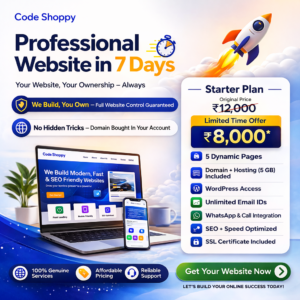
Every CodeShoppy website includes a free SSL certificate configured and maintained as part of our hosting setup. Call us at +91 88070 34653 — we ensure your website is secure, trusted, and properly configured from day one.